
Ask an Expert: The Skills AI Can’t Replace: Lessons for the Next Generation and the Current Workforce
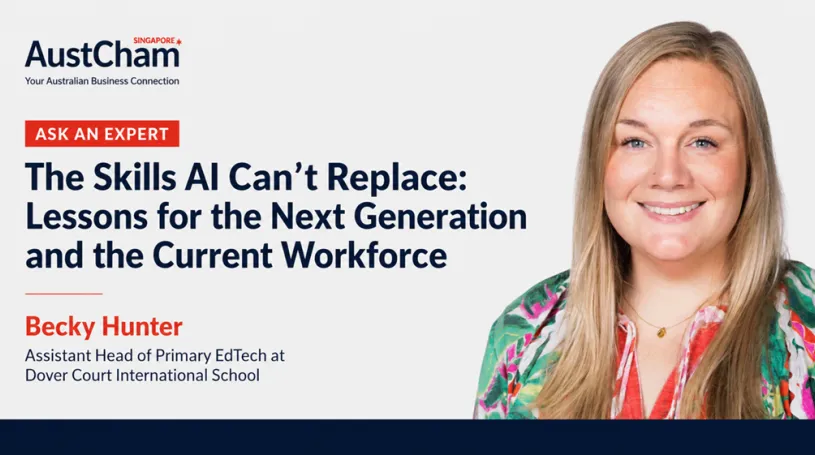
As AI reshapes how we live and work, the capabilities schools are prioritising for students are the same skills business leaders are now racing to build in their own teams. In this edition of Ask an Expert, Becky Hunter, Assistant Head of Primary EdTech at Dover Court International School, explores how schools are developing these distinctly human capabilities, and what it signals for anyone thinking about future-ready talent, in the classroom or the boardroom.
Q: How can we prepare young people for careers and challenges that do not yet exist?
A: Education can no longer focus only on what students know. Knowledge remains important, but when information is instantly accessible, young people need to understand how to evaluate, question and apply it in meaningful ways.
That means developing capabilities that technology cannot replace, including curiosity, critical thinking, creativity, collaboration, adaptability and compassion. Young people also need opportunities to apply these skills to authentic challenges, test different approaches, and learn from both successful and unsuccessful attempts.
At Dover Court International School, students learn alongside peers representing more than 65 nationalities, as well as a wide range of backgrounds and learning profiles. Through these daily interactions, they learn to listen, share ideas, question thinking, learn from one another and work collaboratively to develop their understanding.
These capabilities matter in the workplace too. Organisations need people who can respond thoughtfully to change, work with different perspectives and continue learning throughout their careers.
Q: What is metacognition, and why does it matter in the age of AI?
A: Metacognition is the ability to think about and understand our own thinking. It helps us recognise how we reached a conclusion, identify gaps in our knowledge and decide when we need to change our approach.
This is especially important when AI can generate an answer almost instantly. Access to information is not the same as understanding. We still need to ask: How do I know this is reliable? What evidence supports it? What might be missing?
At Dover Court International School, structured thinking routines such as Circle of Viewpoints and Compass Points encourage students to explore different perspectives, question their initial thinking, identify knowledge gaps and develop their ideas through discussion and reflection. These habits help students become more thoughtful and independent learners.
In a future where information is increasingly accessible, the real advantage will belong to people who can think critically, learn continuously, and ask better questions. That is why metacognition can be considered a student’s superpower.
Q: Can confidence be taught?
A: Confidence is not something children simply have or do not have. It develops through experience.
Schools play an important role by giving students opportunities to speak, perform, lead, solve problems, share ideas and take on meaningful challenges in an environment where it is safe to make mistakes and learn from them.
Many people think confidence comes from getting things right. In reality, confidence grows when young people discover that setbacks are something they can manage and learn from. When they are encouraged to try, reflect, adapt and try again, they build trust in their own ability to overcome challenges.
The same is true for adults. In a rapidly changing workplace, confidence comes not from always having the answer, but from knowing that we can learn, adapt and make progress.
Q: Which human capability will be most important in an AI-enabled world?
A: Curiosity may be the most fundamental because it drives learning, creativity, innovation and problem-solving. It encourages young people to ask questions, explore unfamiliar ideas and seek out different perspectives.
Behind almost every breakthrough, invention, or positive change is someone who was curious enough to ask, “Why does it work this way? Could there be a better solution?”
AI can generate an answer quickly, but recognising which question needs to be asked still requires human insight, context and judgement. Technology should therefore support our thinking, not replace the intellectual effort involved.
For students and professionals alike, the advantage will belong to those who remain curious enough to question assumptions, explore alternatives and keep asking better questions.
Q: Why is an inclusive definition of success important or future leaders and changemakers?
A: The world needs people with different strengths, perspectives and ways of contributing. Academic achievement is important, but it is not the only measure of a person’s potential.
Some young people may become researchers, entrepreneurs or business leaders. Others may thrive as artists, innovators, community builders or changemakers. Our responsibility as educators is to help every student recognise their strengths, understand the contribution they can make and find a pathway that enables them to thrive.
At Dover Court International School, this philosophy is reflected in the different diploma options in Sixth Form so that students can choose a route aligned with their strengths, ambitions and ways of learning. It is also reflected in how we celebrate qualities such as creativity, resilience, leadership, social impact, and a pioneering mindset alongside academic success.
In schools and workplaces, inclusion is not separate from success. When people learn and work alongside others with different experiences and perspectives, they develop a richer understanding of collaboration, contribution and belonging.
The goal is not for everyone to follow the same path. It is for every person to recognise that they have a path, and to develop the confidence to pursue it.
Ask an Expert is a monthly series in which we call on subject experts within the AustCham Singapore community to answer questions that we may have on a specific topic. The strength of our community is in the diverse expertise within our membership, and we want to use this initiative to tap on the knowledge of our members to enrich the community as a whole.
Our Expert for this month is Becky Hunter, Assistant Head of Primary EdTech at Dover Court International School. Becky has been teaching for 12 years and has a wealth of knowledge of Lower and Upper Key Stage 2.
Find out more about Becky here.